
Indoor 169 And 329 Axion-Pro Display
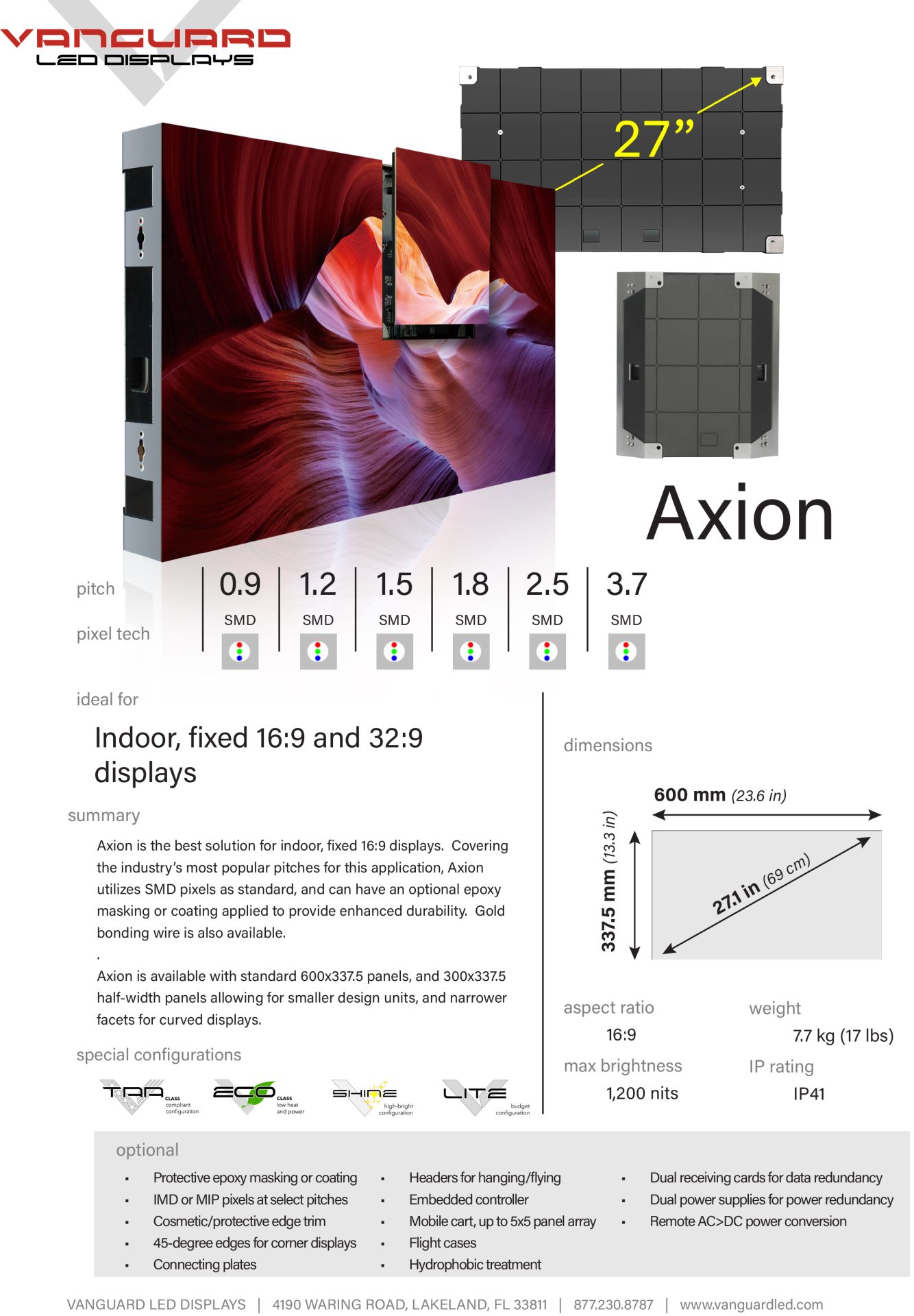
Axion is the best solution for indoor, fixed 16:9 displays. Covering the industry’s most popular pitches for this application, Axion utilizes either SMD or IMD pixels as standard, depending on the pitch, and can have a GOB epoxy protective coating applied. Axion is available with standard 600×337.5 panels, and 300×337.5 half-width panels allowing for smaller design units, and narrower facets for curved displays| series name | Axion {AX) |
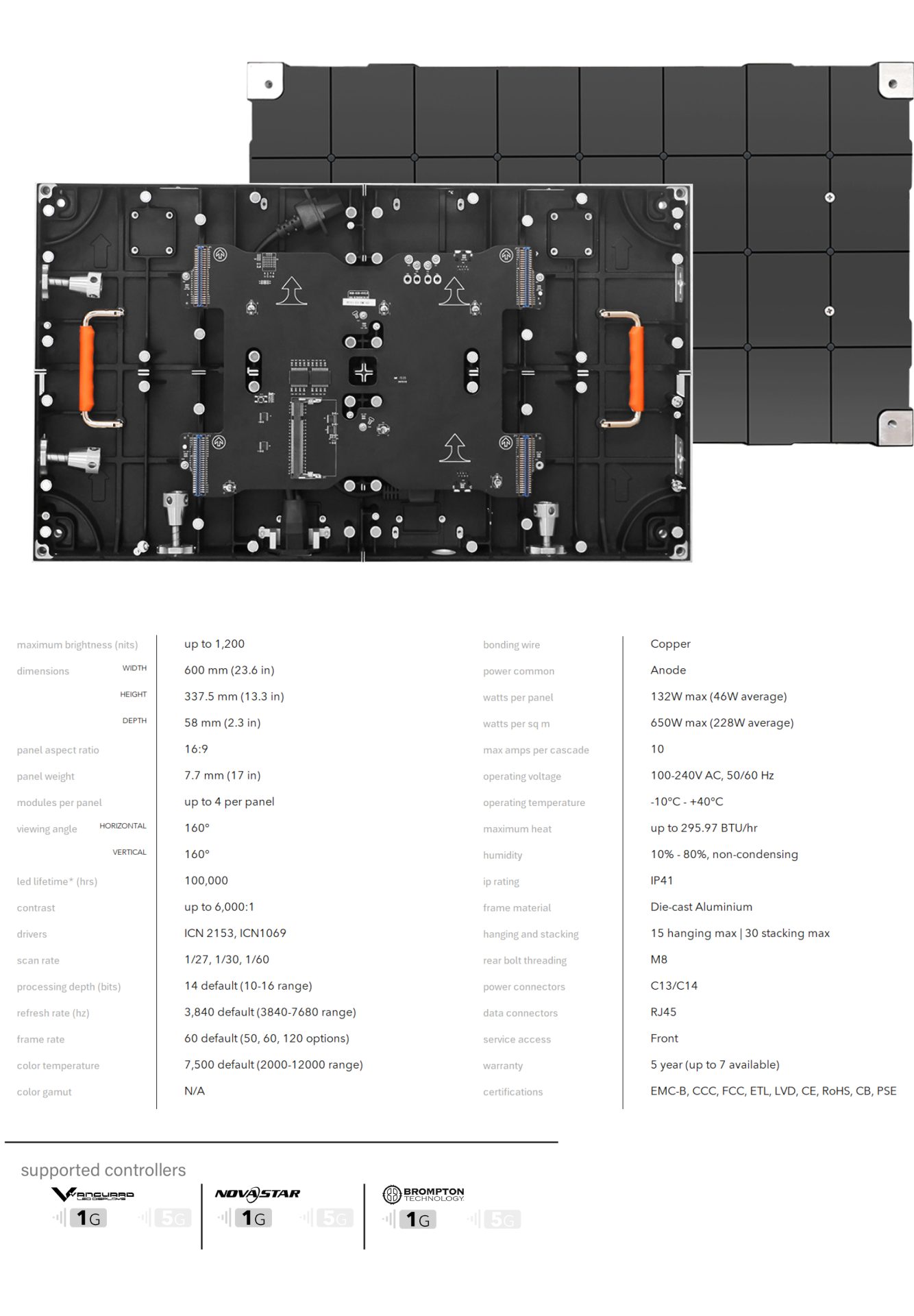
| maximum brightness (nils) | up to 1,200 |
| bonding wire | Copper |
| dimensions | |
| ‘w’IDTH | up to 600 mm (23.6 in) |
| HEIGHT | 337.5 mm (13.3 in) |
| DEPTH | 58 mm (2.3 in) |
| panel aspect ratio | 16:9, 8:9 |
| panel weight | up to 7.7 kg (17 lbs) |
| modules per panel | up to 4 per panel |
| viewing angle | |
| HORIZONTAL | 160″ |
| VERTICAL | 160″ |
| led lifetime” (hrs) | 100;000 |
| contrast | up to 6,000 1 |
| drivers | ION 1069, ICN 2153 (depencfing on pitoh) |
| scan rate | 1/15, 11.27, 1/3-0, 1160 (depending on pitdh) |
| processing depth (bits) | 14 default(10-16 range) |
| refresh rate (hz) | 3,840 default [3,840 range) |
| frame rate | 60 default (50, 60 options) |
| col or temperature | 7,500 default (200Qc12000 range) |
| color gamut | NIA |
| bonding wire | Copper |
| power common | Anode |
| walls per panel | 55-138W max (1948W average) |
| watts per sq m | 540c680W max (189-238W average) |
| max amps per cascade | 10 |
| operating voltage | 100-240VAC, 50/60 Hz |
| operating temperature | (-)1O”C -+ 40″C |
| maximum heal | 187-471 BTU/hr (depending on pitch and panel size) |
| humidity | 10% – 80%, non-condensing |
| ip rating | IP41 |
| frame material | Die-cast Aluminium |
| hanging and slacking | 15 hanging max I 30 stacking max |
| rear boll threading | M8 |
| power connectors | G13/C14 |
| data connectors | RJ45 |
| serv1ce access | Front |
| warrant | 3 year (upto 5 available) |
| cerliFications | 5MC-B, CCC, FOG, ETL, LVD, OE, RoHS,GB, PSE |
Video is shot in a 16:9 native aspect ratio. Therefore, LED display cabinets made in a 16:9 aspect ratio fit standard HD and 4K video content with no need to scale or crop. This means that the images are shown exactly as they were shot for broadcast and and live House of Worship video services.
The distance at which viewers are to see the LED display will determines the required pixel pitch. The smaller the pixel pitch the higher the resolution allowing viewers to be closer to the LED display. For indoor use, pitches range from 0.6mm to 2.5mm.
GOB refers to a protective epoxy layer that covers the entire LED display. This coating makes the display stronger by shielding it from dust, impact, and moisture. It’s useful for displays in high traffic areas, public spaces or where viewers are allowed to be very close to the LED display.
Yes. Many indoor LED systems such as Axion-Pro, come with modular panels and half-width units. These features allow for the creation of curved screens or displays with unique shapes. There are also flex tiles used in the Cerium Series that can bend in any direction allowing for the creation of cylinders and domes.
SMD- Surface Mounted Device- Technology
The SMD process encapsulates three (3) chips, a red, a blue, and a green, into a single bulb/lamp which lamps are then affixed to the PCB board.
The smallest pixel pitch that can be achieved with SMD is P0.9.
The circuit design for SMD, has both the Positive pole, the Anode, and the Negative pole, the Cathode, facing upwards.
The SMD design has brackets and supports that require multiple soldering points.
The failure rate of SMD lamps is estimated at 50-100/ppm.
The colors that can be achieved by SMD, at present, are deeper and brighter than the colors that can be achieved with COB and Chip-Flip technologies.
Chip-On-Board (COB) Technology
COB solders three (3) very fine LED chips, 1 red, 1 blue and 1 green, DIRECTLY to the PCB Board resulting in a perfectly flat, uniform LED surface. which enables a flawless encapsulation of the LED chips, when the epoxy resin finish is applied. As a result the surface of the LED display is anti-static and impact, dust and humidity resistant.
COB eliminates the need for brackets and supports, thereby reducing the number of soldering points. Fewer soldering points result in fewer failures.
Chip-On-Board (COB) Technology allows for the development of very small, very reliable pixel pitches as low as P0.6 at present.
Chipflip- Technology
”CHIPFLIP” is a revolutionary new technology of encapsulating very fine chips to PCB boards using epoxy resin.
The circuit design for “CHIPFLIP” for both the Positive and Negative electrodes face downward.
There is no soldering in the ” CHIPFLIP” Process”! The chip and substrate are electrically and mechanically interconnected by extremely strong solder paste bonding.
The “Chipflip Process” also employs Common Cathode technology whereby the electric current only passes through the Cathode, the negative pole or the ground. Power is drawn only as needed. As a result, heat generation is very low.